Bao La Bamboo Weaving Village – A Quiet Morning in Quang Dien, Hue
From central Hue, the ride took me roughly 40 minutes by motorbike. The road was peaceful, with green rice paddies stretching along both sides and the faint, fresh smell of young rice in the air. After crossing An Lo Bridge, I slowed down for a moment and enjoyed the breeze coming from the river.
My first impression of Bao La Bamboo Village was that it didn’t really feel like a tourist attraction. There were no big signs announcing that I had arrived at a famous handicraft destination. Instead, I found narrow village lanes, red-tiled roofs, leafy gardens, and people sitting outside their homes with bamboo strips moving quickly between their hands.
The sounds were simple: bamboo being split, strips being woven, conversations between neighbors, and occasional laughter. Nothing seemed staged for visitors. People were simply doing what they normally do.
That was exactly what I liked about Bao La.
See more >>> Hoi An Bamboo Handicraft Workshop at Cam Thanh Coconut Village.
Stories Told Through Bamboo and Skilled Hands
One of the first people I spoke with was an older man who looked to be around 60. He explained that some bamboo needs to be soaked in mud for an extended period to make it flexible enough for weaving. Without proper preparation, he told me, the strips can easily break.
He handed me a strip and encouraged me to bend it.
I was surprised by how flexible it felt.
Watching him work made me appreciate just how much preparation goes into something as ordinary as a basket. The final weaving may look effortless when an experienced artisan does it, but the process requires patience, precision, and years of practice.
Nearby, a younger woman was weaving bamboo lampshades for an order going to Hanoi. She told me the price was around 180,000–200,000 VND per piece. When I joked that the lamps looked stylish enough for a designer furniture shop, she laughed.
That conversation made me look at Bao La’s products differently.
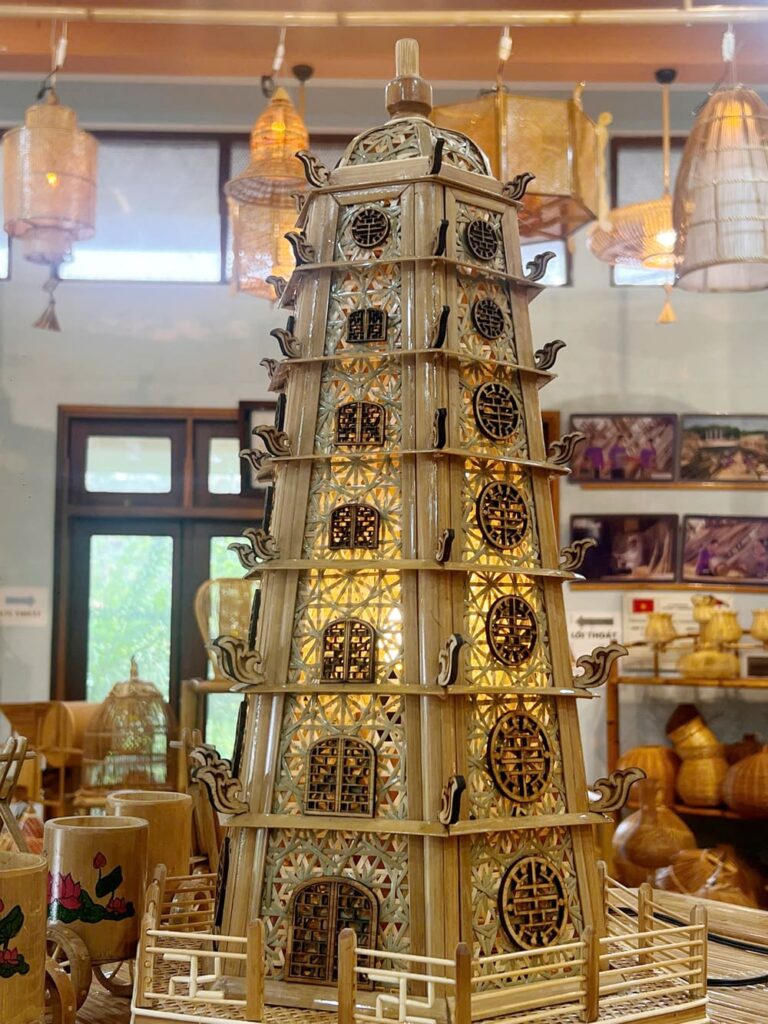
These were no longer simply traditional household items for rural families. The craft was adapting to modern tastes. Alongside familiar baskets and trays, I noticed bamboo chairs, lampshades, planters, and decorative pieces that would look perfectly at home in cafés, restaurants, resorts, and homestays.
I Bought a Traditional Market Basket
Of course, I couldn’t leave without buying something.
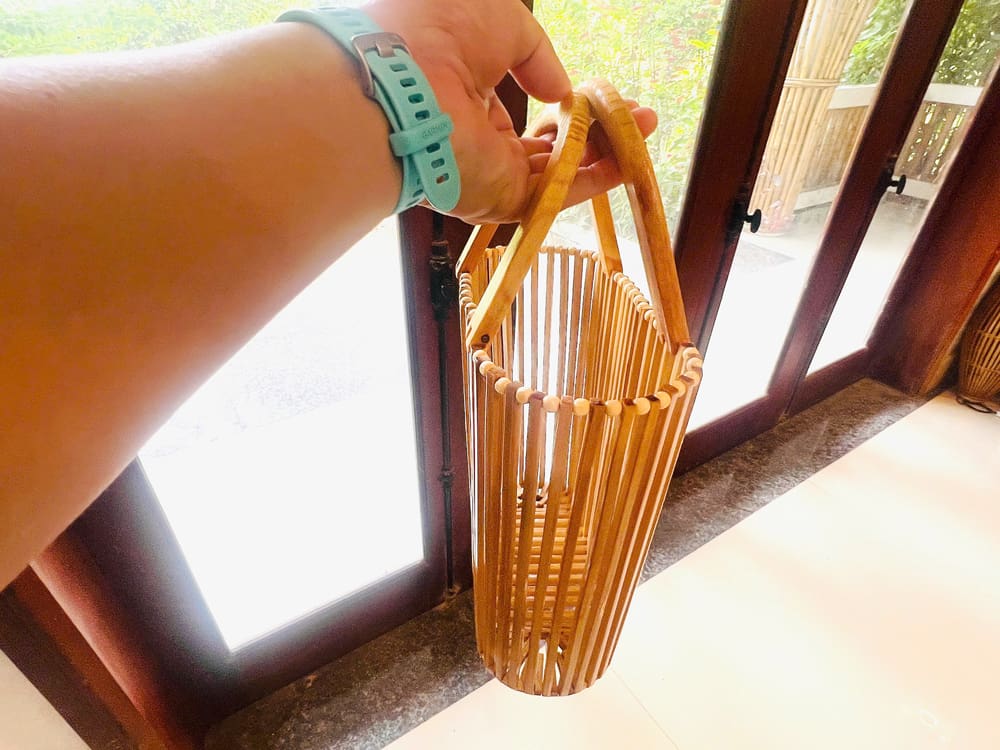
I chose a traditional market basket that immediately reminded me of the baskets my grandmother used to take to the village market. It cost me 150,000 VND. The weaving was firm and neat, and the basket felt surprisingly strong for something made from such simple natural material.
The seller told me that, if properly cared for and kept dry, it could last for several years.
I carried it around for the rest of the day, slightly amused by how much attention it attracted. A few weeks later, I took it with me to a supermarket in Hue, and people noticed it. Later, while I was in Da Nang, a foreign traveler even asked me where I had bought it.
It was just a basket, but somehow it had already become a conversation starter.
What Makes Bao La Different from Other Craft Villages?
I’ve visited several craft villages around Central Vietnam, including Thanh Ha pottery village and handicraft communities around Hoi An. Popular places can be lively and interesting, but they also tend to have more visitors, souvenir shops, and experiences designed specifically for tourists.
Bao La felt different.
The artisans weren’t waiting for tourists to arrive before starting their work. They were already weaving. If you happened to stop and watch, they continued working. If you bought something, great. If you didn’t, that seemed perfectly fine too.
That lack of performance was refreshing.
It reminded me of Cam Ne Mat Weaving Village in Da Nang, another traditional craft community where the future of the craft has become a concern. Bao La gave me a more optimistic impression because weaving remains connected to actual orders and household income.
That distinction matters.
A craft survives most naturally when people can still make a living from it. Heritage is important, but tradition becomes much stronger when it remains useful in everyday economic life.
Bao La Bamboo Weaving: Some Numbers Behind the Craft
During my visit, I also learned more about the work of the Bao La Cooperative. The cooperative produces a range of bamboo products for customers in different parts of Vietnam, particularly Hue, Da Nang, and Hanoi, with some products also reaching overseas markets.
Income varies depending on experience, workload, and the type of products being made. The figures shared with me were roughly 5–8 million VND per month for many artisans, while experienced workers could earn around 7–10 million VND.
For rural households, this kind of work offers an important advantage: artisans can earn an income without necessarily leaving their community. They can combine weaving with farming, household responsibilities, and family life.
That balance is one of the reasons traditional bamboo weaving continues to have value beyond its cultural significance.
I Planned to Stay for an Hour. I Stayed Half a Day.
My original plan was simple: spend an hour or two at Bao La and then continue exploring Hue.
It didn’t quite work out that way.
I ended up staying for almost half a day.
There was tea, conversation, the steady sound of bamboo being woven, and plenty of small details that I would have missed if I had simply arrived, taken a few photographs, and left.
One of the most memorable moments was meeting an elderly woman who was still weaving at around 80 years old. Her hands trembled slightly, but they remained remarkably steady as she continued working.
I asked her why she still wove.
She smiled and gave me a wonderfully simple answer:
“I weave so I won’t feel bored.”
That sentence stayed with me.
For her, weaving wasn’t just about money. It was something to do, something familiar, something that had become part of the rhythm of her life.
Practical Tips for Visiting Bao La Bamboo Village
If you want to experience Bao La Bamboo Weaving Village for yourself, the easiest approach is to search for “Bao La, Quang Dien” on Google Maps. The village is approximately 12 km from Hue city center and makes an enjoyable motorbike trip through the countryside.
I recommend going in the morning. This gives you a better chance of seeing artisans at work before some residents head out to their fields or become occupied with other afternoon activities.
For shopping, visit the Bao La Cooperative, where you can see a wider selection of handmade products. If you’re looking for something specific for your home, it is also worth asking about custom sizes and designs.
Typical Bamboo Products and Prices
- Market basket: 60,000–80,000 VND
- Large bamboo tray (nia): 100,000–120,000 VND
- Hanging bamboo lampshade: 250,000–400,000 VND
- Bamboo chair: 600,000–1.2 million VND
- Custom products: Available for selected home décor projects
Prices can vary depending on the size, design, materials, and amount of work required. For larger pieces, especially furniture, it is best to confirm the final price and delivery arrangements directly with the cooperative or artisan.
My Takeaway from Bao La
Every handmade object seems to have a little more warmth than something produced by a machine.
My Bao La basket isn’t perfect. The bamboo tones aren’t completely uniform, and some strips are slightly thicker than others. But those little irregularities are precisely what I enjoy about it.
It isn’t perfect, but it has character.
When I look at it now, I don’t just see a basket. I remember the quiet village road, the rice fields, the sound of bamboo being split, the artisans sitting outside their homes, and that elderly woman who simply wanted to keep her hands busy.
For me, Bao La is not just about bamboo handicrafts. It is about patience, resilience, and the slower rhythm that still exists in the countryside around Hue.
If someone asks me where to go in Hue after visiting the tombs, pagodas, and imperial landmarks, I would suggest going a little farther into Quang Dien. Sit with the weavers. Watch their hands work. Talk to them if they are happy to chat.
Then watch how ordinary bamboo strips gradually become baskets, furniture, lamps, and objects that carry a little piece of village life with them.
Sometimes, the most authentic travel experiences aren’t the ones created for tourists. They’re the moments when you simply arrive somewhere, sit down, and watch local life continue as it always has.
YOU MAY LIKE IT

Experience Bao La Bamboo Weaving Village class – Quang Dien, Hue 1 Day Tour
Bao La Bamboo and Rattan Village in Quang Dien, Hue, is home to village artisans who dedicate their lives to preserving traditional weaving. This is not just a village—it feels like a living...