Tra Que Herb Village – A Quiet Taste of Local Life in Hoi An
After a few days in Hoi An, I usually feel like getting away from the busy streets for a while. The Old Town is beautiful, especially in the evening, but there is another side of Hoi An that I enjoy just as much: the quiet countryside around it. One of my favorite places for that kind of escape is Tra Que Herb Village.
Click to book Tra Que Village via WhatsApp ›
For further inquiries regarding Hoi An Explorer Travel, please feel free to reach out to Ms. Tina at 0916.52.8884

Tra Que Vegetable Village
Tra Que is not the sort of place where you arrive with a long sightseeing checklist. There is no grand monument waiting at the entrance. Instead, you find small gardens, narrow lanes, bicycles, farmers at work and the fresh smell of herbs in the air. For me, that is exactly what makes a visit worthwhile.
See more details tour >>>Tra Que Vegetable Village Tour – Experience Farming and Cooking Class
Where Is Tra Que Herb Village?
Tra Que is a farming community in the Cam Ha area, just outside central Hoi An. It is close enough to reach without spending much time on the road, yet the atmosphere changes surprisingly quickly once you leave the busier parts of town.
On the way there, the scenery gradually becomes more open. Houses and cafés give way to vegetable gardens and quieter lanes. If you arrive in the morning, you may see farmers watering their crops, preparing planting beds or carrying freshly harvested herbs home. It feels less like visiting a tourist attraction and more like entering a normal working neighborhood.
The First Thing You Notice: The Smell of Fresh Herbs
What I remember most from my first walk around Tra Que was the smell. You notice it before you really start looking at the gardens.
There are beds of leafy vegetables and aromatic herbs growing close together. Basil, mint, Vietnamese coriander and other local greens are familiar ingredients in Vietnamese cooking, but seeing them growing in neat rows gives you a different appreciation for them.
Tra Que has a long farming tradition, and local growers have developed ways of working with the soil and natural materials available in the surrounding area. Organic materials, including seaweed traditionally collected from nearby waterways, have been used to support the gardens. The farming landscape is made up of many smaller plots rather than one enormous commercial field, which gives the village its particular character.
A Slow Morning in the Gardens
If you ask me when to visit, I would choose the morning. The air is usually more comfortable, the light is softer for photographs and the gardens are already active.
I like walking slowly here rather than trying to see everything at once. You might pass someone carrying a basket of vegetables, hear water running over a garden bed or notice tiny drops of water sitting on the leaves. None of these things sounds spectacular, but together they create the atmosphere that makes the countryside around Hoi An special.
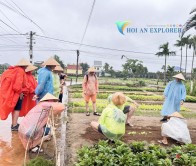
Visitors can also join farming activities arranged with local hosts. Depending on the experience, you may help prepare the soil, plant young vegetables, water the beds or learn some of the basic techniques used by local growers.
The work itself is not complicated, but it changes the way you look at food. After spending even a short time in the garden, a handful of herbs served with lunch no longer feels like an insignificant side dish.
Tra Que Is Still a Real Farming Community
One thing I think travelers should understand before visiting is that Tra Que is more than a sightseeing stop. Farming is still part of everyday life here.
That means visitors should treat the gardens as working spaces rather than photo sets. Stay on appropriate paths, listen to the local host and ask before touching or picking anything. A little respect makes the experience more comfortable for both visitors and the people who live and work there.
This also gives you a chance to see a more ordinary side of Hoi An. Instead of looking for something spectacular, pay attention to the small scenes around you: an old bicycle beside a garden, a farmer sorting vegetables, a basket being filled with herbs or a quiet lane with almost no traffic.
What Can You Do at Tra Que?
A visit can be as simple or as active as you want. Some travelers come just for a walk and photographs, while others spend several hours combining the village with food and farming activities.
- Walk through the vegetable gardens and explore the quiet lanes.
- Join a hands-on farming session with local growers.
- Learn about herbs commonly used in Central Vietnamese cuisine.
- Try simple gardening activities such as watering or planting.
- Combine a farm visit with a Vietnamese cooking class.
- Cycle through the surrounding countryside.
- Take a break from the crowded parts of Hoi An and enjoy a slower morning.
Why Tra Que Makes Sense with a Cooking Class
For food lovers, Tra Que becomes even more interesting when you connect the garden with a cooking experience.
Vietnamese meals often come with a generous plate of fresh herbs. In Hoi An, these greens are an important part of the dining experience rather than just decoration. Visiting the place where some of these ingredients are grown gives that familiar meal a little more meaning.
A typical experience might begin in the garden, continue with picking or preparing ingredients and finish with cooking and eating. I like this kind of tour because it does not feel like two unrelated activities. You can follow the ingredients from the soil to the kitchen and finally to your plate.
Tra Que for Photographers
You do not need professional photography equipment to enjoy the village. In fact, I think a simple camera or phone is enough.
The best photographs are often the unplanned ones. Look for morning light across the vegetable beds, a farmer working between rows of plants, baskets of freshly harvested greens or bicycles moving along the narrow roads.
Try not to turn every moment into a posed photograph. If someone is working, give them space. The natural rhythm of the village is much more interesting than a staged scene.
When Should You Visit Tra Que?
Morning is generally the most pleasant time for an outdoor visit. It is cooler than the middle of the day and you are more likely to see farming activities taking place.
Hoi An can become quite hot, particularly during sunny periods, so comfortable clothing, water and sun protection are useful. After rainy weather, the paths and garden soil may be muddy, which is another reason to wear practical shoes if you plan to take part in farming.
A Few Things I Would Do Before Visiting
I would keep the visit simple. Wear clothes that you are comfortable moving around in, especially if you plan to work in the garden. Bring water and avoid carrying anything that you would worry about getting dirty.
Most importantly, remember that this is someone’s workplace and home. Do not walk across planting beds just to get a photograph, pick herbs without permission or interrupt people while they are working. Small gestures of respect make a big difference.
Is Tra Que Herb Village Worth Adding to a Hoi An Trip?
I would say yes if you want to see more than the famous streets of the Ancient Town.
Tra Que does not try to impress you with a spectacular landmark. Its appeal is much quieter. You come for the gardens, but you leave remembering the smell of herbs, the sound of water, the people working in the fields and the slower rhythm of countryside life.
That is why I would not rush through Tra Que in thirty minutes just to say that I have been there. Give yourself a little time. Walk around. Talk to a local farmer if there is an opportunity. Try a farming activity. Have lunch with fresh herbs afterward.
Hoi An is famous for its old houses, lanterns and food, but places like Tra Que help explain where part of that food culture comes from. For travelers who enjoy genuine local experiences, a quiet morning among the gardens can be one of the simplest and most memorable things to do outside the Old Town.


YOU MAY LIKE IT

Stepping into the Earthy Rhythm of Tra Que Herb Village
If you ever want to peel back the tourist layers of Hoi An and feel the authentic heartbeat of local life, you need to pedal just a few kilometers outside the ancient town center. Nestled...